
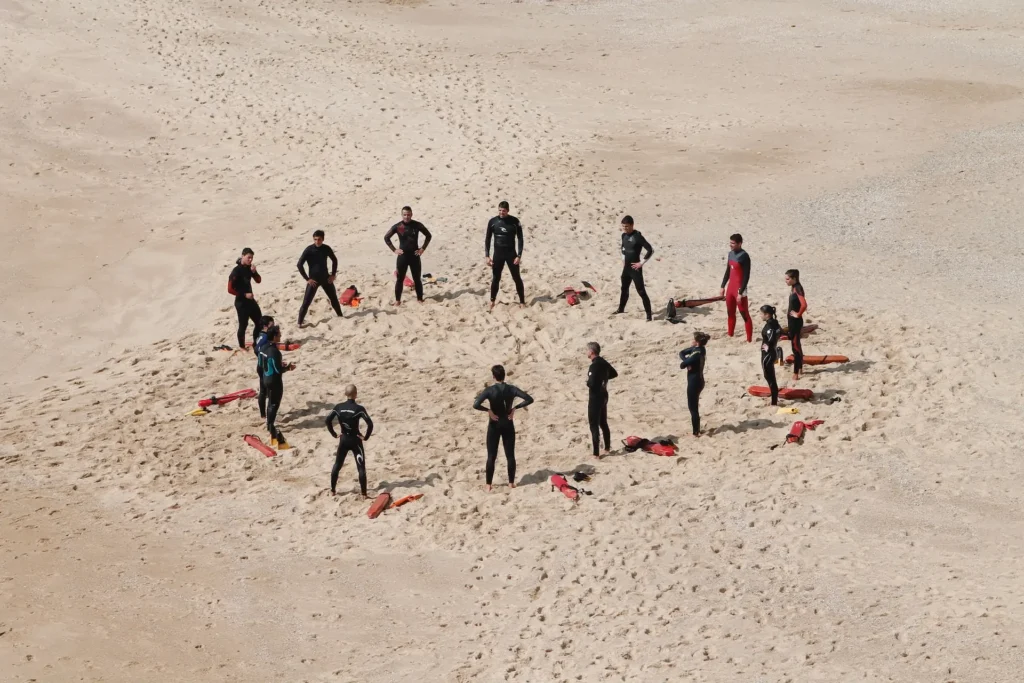
Have you ever heard of the term organisational constellations? Or how subconscious projections can influence cooperation within a company?
According to Klaus-Peter Horn and Regine Brick, today’s economically successful companies and managers who skilfully manage relationships are referred to as „well positioned“
While this is true to a certain extent, but companies that are well „positioned“ operate beyond the conscious level.
They also delve into the realm of the subconscious.
What might this look like?
Scenario i
Conflict within the team
Matthias, the managing director of a small-to-medium enterprise (SME), is in conflict with Jan, one of his best department heads. Despite several discussions, no solution seems to be in sight. In a controlled environment, two people are placed in a room together. They look at each other and there is some aggression in the air; for a team, they are standing rather far apart. A third person stands in a circle with them. Then, upon receiving a signal, Jan turns away and looks at the other person. This is a proof of access, showing that Matthias is only the trigger for this different issue. Matthias is the managing director of an SME and has a conflict with Jan, who is one of his best division managers. After several discussions, it seems that there is no solution in sight. In a protected setting, the two men are positioned in a room. They look at each other and there is an air of aggression, despite them being a team. They are standing rather far apart. A third person stands in a circle with them. Then, upon receiving a movement impulse, Jan turns away and looks at the other person. This proves that it is a different issue and that Matthias is only the trigger for it.
This scenario is known as an organisational constellation. It is used to find out why a conflict seems unsolvable, for example. Although we humans are fundamentally cooperatove, sometimes it just doesn’t work out.
It is therefore important to understand that hidden, unconscious experiences and habits are often deeply rooted emotionally and cannot be changed overnight. This requires a method that opens up emotional barriers enabling new ways of working and seeing things, without any esoteric frills or incense sticks.
No voodoo or pendulum swinging
An organisational constellation is a process that brings order to a team or decision-making process. There are certain hierarchical dynamics within a company that must be observed. If these are violated, unrest or chaos ensues. If normal communication within the company is not achieving the desired results due to an underlying problem, it is important to identify the root cause, or meta-theme.
Without question, there is no blame
This is not about finding someone to blame. As we all know, we often say one thing but mean something else entirely.
Scenario II
Promotion of your superiors
Your boss is about to get promoted, but she is constantly in a bad mood. That's great news – but she snaps at you for no apparent reason at every opportunity. Why?
What could the underlying theme (meta-theme) be here? Perhaps fear or insecurity? It is something, that we would never openly admit in society, especially if we arein a leadership position, because having a career is seen as great, important and right. However, deep-seated insecurities that we often fail to acknowledge, can lead to such an overreactions.
We all experience fear of failure, insecurity and disorientation at some point!
Sooner or later, these issues will affect all of us at work. It is often difficult to address the issues rationally, as we are all masters at hiding our true feelings. In extreme situations, a different approach is needed to get to the heart of the matter – and that approach is organisational constellations.
Wo, what happens during an organisational constellation?
Let’s take a closer look at the process:
Representatives are used to set up a team constellation in a safe environment. This does not mean that those in conflict face each other and engage in a heated discussion in front of the group, but rather that a person is chosen to represent each „party“ in the construct.
Together with the constellation facilitator, a solution is worked out. This may involve changing or adding additional resources. Group dynamics reveal hidden problems and address them directly without judgement. After all, everyone is in this together and is here to find a solution. This development process creates positive change for everyone involved.

My conclusion
This may sound very abstract in writing – you have to experience it to fully understand what it’s all about. The bottom line is that it really works – and it’s exciting! Many of us, myself included, have already tried organisational constellations. The possibilities this opens up are too numerous to summarise here.
Have you realised while reading this that this is also an issue for you too? Get in touch and we can discuss whether an organisational constellation could be the solution for you!
Here is the link to our next constellation evening and what you can expect.
Because, as Virginia Satir said:
„Working life is not what it should be. It is what it is. The way we deal with it makes all the difference.“

