
It is expected that 44% of workers’ core skills are will change within the next five years.
According to a report by the World Economic Forum, companies expect that 44% of their employees‘ current core skills to come obsolete by 2027.
Why? Digitalisation is increasing, technological changes are advancing imagined, and many jobs, particularly those involving routine tasks, will disappear and be replaced by new roles.
In 2023, the World Economic Forum published its Future of Jobs Report and named the 10 most important skills:
- Analytical thinking
- Creative thinking
- Resilience, flexibility and agility
- Motivation & Self-Perception
- Curiosity & lifelong learning
- Understanding of technology
- Reliability & attention to detail
- Empathy & active listening
- Leadership & social influence
- Quality control
Cognitive skills were already at the top of the list in the 2023 Future of Jobs Report. Since then, analytical thinking has been regarded as a core competency by companies.
This view remains unchanged – which is hardly surprising, giving that an ever-increasing amount of information and data needs to be processed and interpreted, particularly in the context of artificial intelligence.
Top 10 in-demand skills by 2027
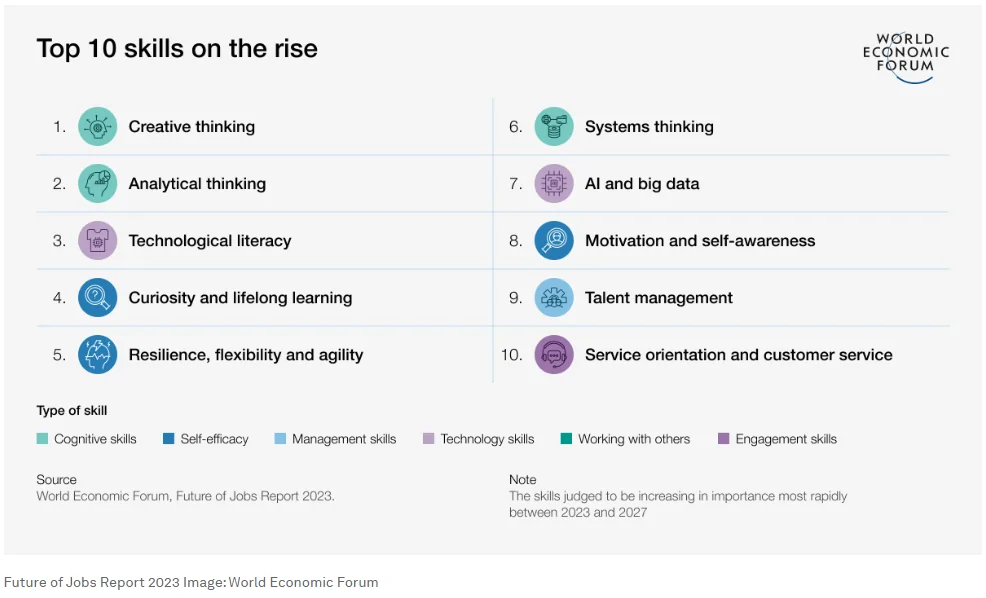
However, it is assumed that creative thinking will become increasingly important in the future overtaking analytical thinking. This view does not surprise me, given that AI learns from us with every query we make. In the future, it will be able to interpret contexts better than any human.
However, creativity, is only triggered to a limited extent by past experiences. Instead, it is the ability to imagine the impossible, which will be another USP (unique selling point) for humans, alongside emotional intelligence. I imagine that AI and humans will inspire each other to develop new ideas.
Training and further education must be at the top of the agenda
Technological competence must be expanded. Consequently, by 2027, six out of ten employees will require training or further education. According to this report, currently only half of employees have access to adequate training opportunities. In order to remain competitive in the market, companies will have to invest more in personal development and digital skills.
In a highly competitive labour market, investing in employee development will be a key unique selling point for employers. #PersonalDevelopment
The 11th superpower

Systemic thinking must be added to the top ten skills. It shifts the focus away from linear-analytical thinking to a more holistic view of things. The strict separation of professional and private life is no longer feasible. The systemic view simply makes it clear in a striking way that the two influence each other. This type of view will help to avoid looking at isolated parts of reality and instead focusing on the complex connections and interactions within a system.
As a constellation facilitator, I consider how the family system influences my clients‘ everyday working lives and vice versa. Which interactions lead to confusion or repeated mistakes? By combining my conscious and unconscious minds, I create harmony, which ultimately leads me to success. Those who understand this develop a superpower that, until now (and I dare say), was arguably reserved for secret services. It involves reactivating dormant qualities (affectionately known as our sixth sense) and turning them into an everyday tool that supports all the aforementioned skills.

My conclusion
We can safely assume that a lot will change in the coming years. Whether or not to invest in further training for existing employees will be crucial to the success of the next few years.
The 11th superpower I mentioned earlier rounds out the mix. Just as we get up and wash every day, we should address our mental state and it effects our lives daily. #Meditation #Yoga #Constellation #Journaling #Visionboards
The train has already left the station, so let’s get to work to prepare for the future.

