
HR-Passonista | Marion Eppinger

A glimpse into the future: the World Economic Forum’s top 10 skills for 2025

Hand hält eine gläserne Kugel, die den Säulengang eines historischen Gebäudes spiegelt, mit warmem Licht und Schatten im Hintergrund.
 

Acoording to the World Economic Forum’s Future fo Jobs Report: „50% of all employees will need to be reskilled by 2025, as technology adoption increases.


The report states that 50% of all current employees will require retraining by 2025, due to increasing prevalence of technology. (Future of Jobs Report.)

Is this a bleak outlook or an opportunity for change?

According to Professor Klaus Schwab, the founder’s Forum and Executive Chairman, we already have the right tools at our disposal to make these changes. Technological innovations that define this era can unleash people’s undiscovered potential – you just need to know how.

So, what are the top 10 skills for the future?

  • Analytical thinking and innovation
  • Active learning and learning strategies
  • Complex problem solving
  • Critical thinking and analysis
  • Creativity, originality and initiative
  • Leadership and social skills
  • Use of technology, monitoring and control
  • Technological development and programming
  • Resilience, stress tolerance and flexibility
  • Argumentation, problem solving and idea generation


The skills of the future can be categorised in four overarching areas: problem solving, self-management, working with people, and the use and development of technology.

Looking at these categories more closely, it is clear at a glance that problem solving is the most frequently mentioned skill. Self-management and the use/development of technology are mentioned equally often, while working with people is mentioned only once. This is somewhat puzzling. Let’s take a closer look:
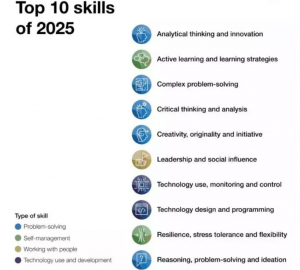
 

Next to each category, you will now find the corresponding top 10 skills.

The top two skills in the last two years were complex problem solving and critical thinking & analysis. Currently, analytical thinking & innovation are in the highest demand, as well as active learning & learning strategies – which is not surprising in times of change. Situations must be analysed and new ideas generated in order to survive.


Person in silbernem Outfit steht vor Ballons und goldenen Sternen, während goldene Konfetti durch die Luft fliegen – festliche Stimmung

The newcomer to the top 10

Active learning and learning strategies have entered the top 10 for the first time. Starting this year, expectations regarding learning have changed. Rather than ‚feeding“ their employees information; instead, companies now expect them to acquire new knowledge independently.

Personally, I think it a shame that leadership and social influencing are „only“ in 6th place – I would have ranked these topics higher myself. Nevertheless, it comes as no surprise that technological skills have become more important and, at first glance, have overtaken interpersonal skills in importance. This is especially true now that digitalisation is saving our current economy. Not so long ago, there was still debate about whether remote working would work at all; today, it is part of everyday business.

It is also interesting to note that resilience, stress tolerance and flexibility have made it into the top 10 too. This is an unexpected statement when you consider the developments of the last year. The pandemic has changed a lot.

This year, the report not only looks at the top 10 skills, but also at the need for further development. It is estimated that by 2025, technology will replace a total of 85 million jobs. However, the good news is that many new professional fields will emerge. In the future, it will be important to connect people, algorithms and machines.


The way forward: retraining and further education

As technology advances, „on-demand“ skills will change completely over the next five years and the so-called „skills gap“ will widen further. (You can find out more about the skills gap in my article https://www.linkedin.com/pulse/upskilling-weiterbilden-statt-austauschen-marion-eppinger/)

Many senior manager anticipate that employees will (have to) acquire many new skills „on the job“. However, this alone will not be enough. Retraining or further training takes time and usually lasts up to six months. The length of the retraining phase also depends on the complexity of the subject matter and can, of course, take longer in sectors such as healthcare and finance.

Most of the training will be delivered in-house in collaboration with online learning platforms and external consultants. This trend was already evident at the beginning of the pandemiccontinuous learning will be an integral part of the modern workplace.

While access to learning materials is now much easier than before, but we must acknowledge: employees will require additional time and financial resources for further training in the future.

My conclusion

What Heraclitus said back then still holds true today:

„Nothing is as constant as change.“

In the future, entrepreneurs and employees will have to adapt to constant change.

In summary, some changes have been observed in the top 10 skills. Only time will tell if these will remain the same until 2025 – it’s almost like looking into a crystal ball and predicting the future. As they say these days: „Nothing is certain.“

Bild von Marion Eppinger ist die #hrpassionista

Marion Eppinger ist die #hrpassionista

Sie ist Influencerin für Trends im HR-Bereich. Richtungsweisend und agil für Top-Themen der Branche.

Du möchtest mehr über dieses Thema erfahren?

Dann trau dich und schreib mir gerne. Wir können ein kostenloses Erstgespräch von maximal 30 Minuten vereinbaren, um gemeinsam etwas tiefer in die Materie einzutauchen.

Connect with the #HrPassionista

Du möchtest mehr über
#whatstrendinginHR wissen?