
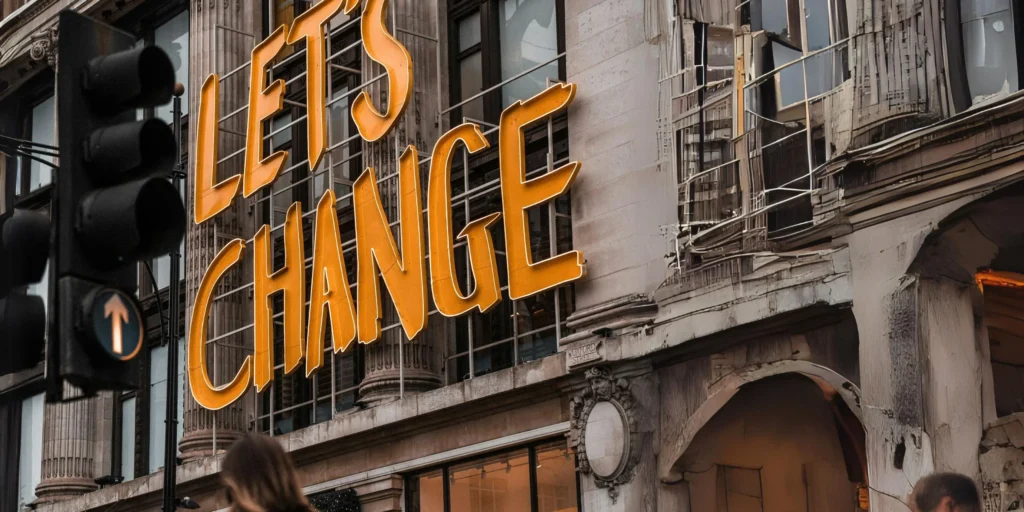
In a world that is constantly changing world, change is at the top of the agenda. But why does change often have negative connotations?
This is a question that preoccupies many of us. Perhaps it is because change is often accompanied by uncertainty and discomfort. The unknown and the new can be frightening.
In this article, I will summarise why it is still important to embrace change, explain how the change process works and highlight what you need to consider when doing so.
The biggest change in life
But let’s pause for a moment and think about a change that most of us strive for and which is also one of life’s biggest changes: relationships. Suddenly no longer being alone and having to coordinate, compromise and share responsibilities may seem challenging at first. Ultimately, however, we take on this challenge because we know what awaits us at the end of it: having someone by our side with whom we want to share our lives.
Changes in the world of work
Looking back on our lives, we realise that change has become a permanent feature of everyday life. From job changes to digitalisation to virtual working – the world around us is constantly and rapidly changing. However, despite its ubiquity, some companies have ignored or missed out on change. Companies such as Nokia, Blackberry, Kodak and Thomas Cook serve as a reminder that passivity is not a viable survival strategy in a changing world.
We must consciously control how we approach change. We should embrace new things, learn from our mistakes and position ourselves as early adopters.
Early adopters are people who use the latest technological innovations, products or fashion accessories.
The valley of tears
However, change is not a linear process. Elisabeth Kübler-Ross‘ „valley of tears“ model shows us that change occurs in phases.
- Phase 1 – Shock: change is coming!
- Phase 2 – Denial: Disbelief, we look for evidence that it is not true.
- Phase 3 – Frustration: Realisation that it is true – sometimes accompanied by anger.
- Phase 4 – Depression: Lack of energy and apparent hopelessness.
- Phase 5 – Exploration: Letting go and initially engaging with opportunities that arise.
- Phase 6 – Adjustment: for the new path, energy returns.
- Phase 7 – Integration: The new situation is being lived.
All seven phases must be completed in order. Although it is a linear process, it often does not work the first time! It may be necessary to repeat individual phases of the change process several times, as circumstances can change repeatedly. So there is no standard formula here.
From denial to acceptance, we undergo a process that enables us to grow and become stronger. It is possible to skip a phase, BUT at some point, we will be thrown back and have to deal with the „skipped“ phase.
When a pet dies, you don’t usually get a new one on the same day. If you do, you will keep referring to the „old“ pet which means the new pet will never be able to integrate, as the loss and the accompanying change have not been processed.
The same applies to the corporate context, of course. You cannot announce a restructure one day and expect employees to have moved the next day. Employees are in phase 1 – shock – and this needs to be processed step by step. This takes time, because Rome wasn’t built in a day.
If employees get stuck in one phase, don’t despair. Talking about it often helps! Ask specific questions and work together to find solutions:
For example: What do you need to be able to deal with the situation better? What would your best friend say if you told her / him about it? On a scale of 1 to 10, how bad do you feel about the change? What do you need to go from point A to B?
Depending on how significant or life-changing something is, it makes perfect sense to seek professional help with the process. This could be with internal organisational developers or with external consultants or coaches. They can help you start the change process, keep it on track and make adjustments and get the workforce on board esnuring that the change is ultimately integrated.
Communication & Celebration
It is therefore important to talk openly about the challenges and celebrate the various phases during the change process. Farewells are just as important as new beginnings! We can only make room for the new and take advantage of the opportunities that change brings when we are prepared to say goodbye to the old.

My conclusion
In a world that is constantly changing world, we must learn to embrace change. Let’s walk this path together and viewing challenges as opportunities for growth and development.
I have already guided several companies through change processes. One thing is certain: there is no single way to integrate change into a company. My approach here is to combine Elisabeth Kübler-Ross’s phase model with systemic work to implement changes. This approach provides valuable insights and often reveals unexpected issues that were not previously overlooked.
to gain a deeper understanding of organisational constellations, I recommend reading my blog post on the subject.
Why is this important? It saves time, money and resources! It allows you to gain a better understanding of situations in advance, so you don’t have go round in circles.
The most important lessons I have learned from change processes is that they take time and need to be discussed repeatedly. It’s better to discuss it once too often than not enough.
Because without change, there is no progress.

